
I sometimes wonder if people suspect I married Becky just so I could gain her parents in the deal. They are one of the best gifts she ever gave me. My second father, Bill MacNabb, passed away last week, and I’ve struggled to articulate an appropriate tribute for him. I’m going to do it as a leadership tribute.
I think what most impressed me was Bill’s faith and humor through a life of storms that would have shaken anyone. He had a one-of-a-kind disease. For over thirty years his doctors tried on diagnosis after diagnosis, sometimes naming diseases that were usually found in women or only diagnosed at autopsy. One doctor ended up calling it “MacNabb’s Disease.” Turns out all the symptoms can be tied to Agent Orange exposure in the Vietnam War. He gave his life in service to his country. If his life had ended back then, however, he wouldn’t have enriched as many lives as he did.
While he grew up without a model for fatherhood, he became the loving, doting father to his girls that he never had himself. He put a lot of energy into creating games for them and forging a lifetime of deep memories. He made sure they knew they were loved. When his daughters each found their life partners, he adopted them as one of his own kids, once they attempted the impossible feat he designed as a test.
No one needed to follow Bill. He was a titled leader—a president, chairman of the board, an elder, and a patriarch of a growing clan—but he didn’t require a title to lead. He had the courage to forge a path when there wasn’t one blazed before. He was willing to do what he wanted to do even if no one followed. Yet I think you’ll see that many followed him.
Finding the humor
Most will remember my father-in-law for his humor, in spite of all his hardships. He joked even if no one got it, because he wanted to make himself laugh. He often cracked himself up, and even if those around him didn’t get it, his laughter was contagious.
When painting became an outlet during a season of brain-diseased-episodes, he created art that only a mother would love. Or only the artist could appreciate. His best friend told him, “Bill, you’re an artist in your own mind.” Bill compounded the joke by scribbling overpriced valuations on the back of his most ridiculous paintings. One Father’s Day years later, when he was in his right mind, we pulled out his art collection from the attic. He hadn’t seen many of these pieces in a long time, and as he saw them he began to laugh. Ugly laughing—tears streaming down his cheeks and his face frozen in a grimace as he struggled to breathe.
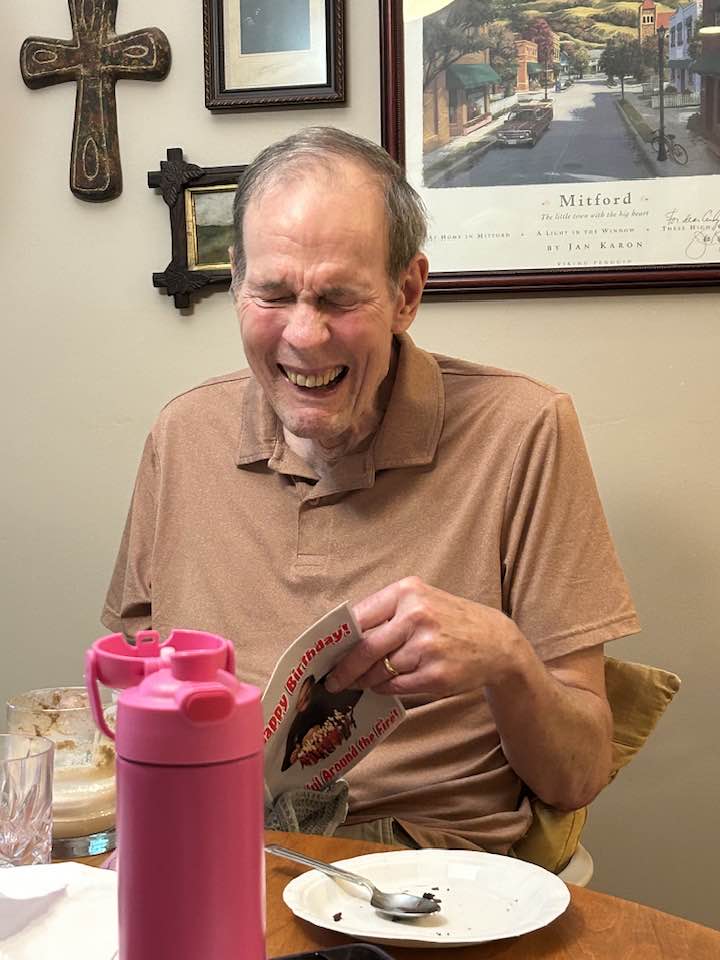
He was often willing to offer himself as the butt of his own jokes, like his tongue-in-cheek alter ego, “Mr. Fix It”—a willing hero who was always depicted applying the wrong tool for the job. He was equally willing to roast his brothers-in-law or send them a two-page invoice after their family enjoyed his hospitality. Or to sacrifice his sons-in-law for comedic purposes. As his first daughter was about to marry me, he said at the rehearsal dinner, “I don’t think of this as gaining a son. I think of it as losing my shirt.”
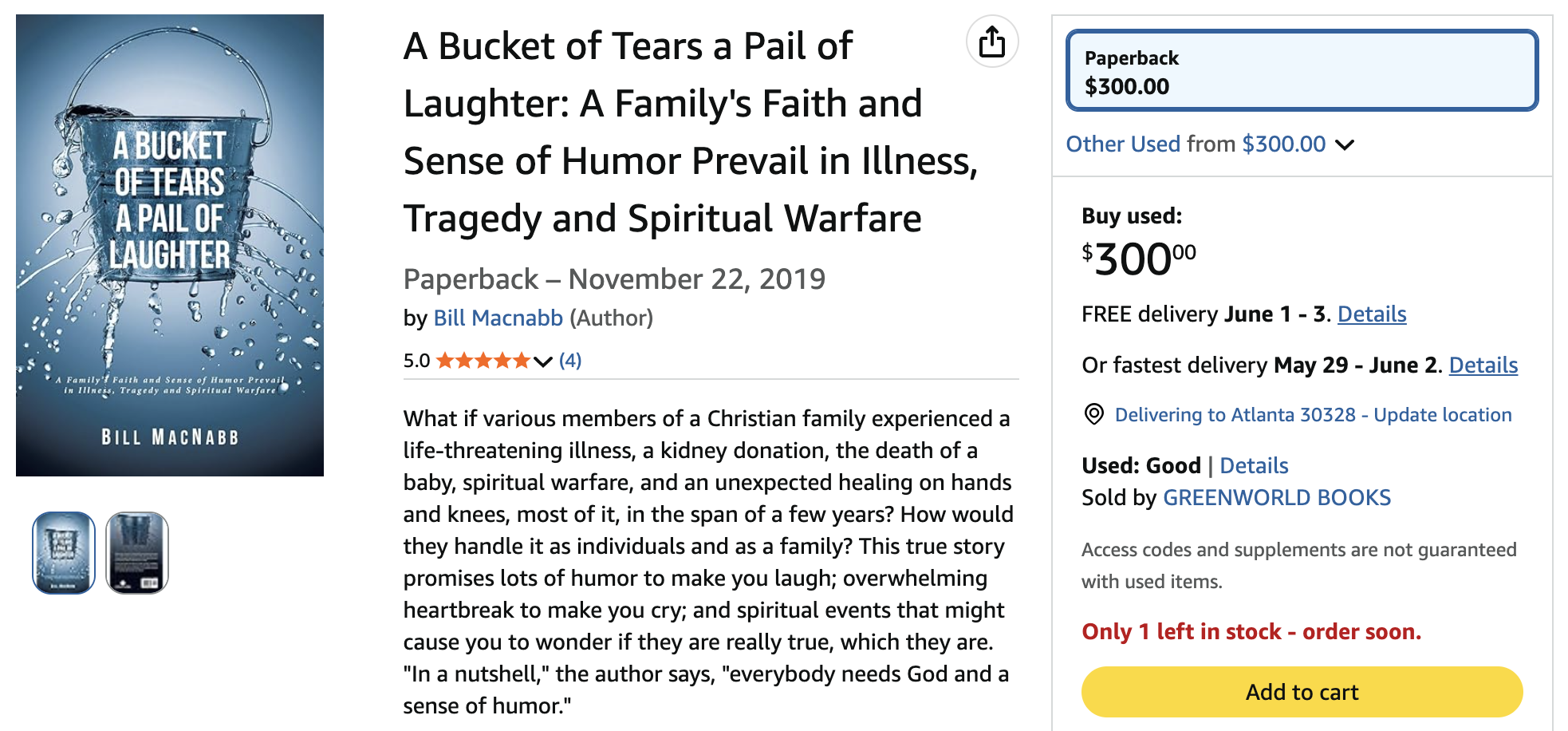
He was also an author in search of an audience. He wrote because he had to, even if few would ever read his work. His written correspondence with his father-in-law is epic, even if written for only one person. As a former journalist, he wanted to publish, and he achieved that goal in 2019 with a book of extremely limited run. It seems perfect that there’s only one copy of his book available on Amazon right now, and there seems to be a bit of price gouging in play. Perhaps they think the author’s death is going to drive up demand in the resale market. Bill would be the first to find the humor in that.
First followers
It’s easy to say a one-of-a-kind doesn’t need others, but that’s actually untrue. The first to follow someone are the ones who define that person as a leader. As John Maxwell once said, a leader with no followers is just taking a walk. Bill MacNabb could have just taken a walk out of step with everyone else, but something about him drew others to participate in his jokes, his writing and his artwork. He had a huge influence on all who knew him, and we wanted to walk at his pace. So let’s talk about his followers for a minute.
One way we participated was to provide an audience. We listened to Bill’s drafts or helped others realize when he was joking. He fed off the reactions to his dry wit or sarcasm. In one case, he concluded a eulogy for his best friend and walked away silently before returning to the microphone to say, “I usually get applause.” I can still see the funeral director shaking his head at the raucous response. Bill loved it when a message intended for one audience was unearthed. Such as a spoof video he created as sales manager for a heating and cooling company, when he explained how profit was lagging sales, and told customers, “If we had known you would have money left over at the end of the year, we wouldn’t have given you the prices we did.”
The audience also has a role to play. The greatest gift those around Bill could give him was to help him lift his jokes, his writing, his artwork to a level of absurdity. For instance, his kids created a local news video to showcase his journalistic ramblings after a tree exploded behind his house: “A tree explodes! News at 11!” Others created inspirational placemats featuring his Mr Fix It photo series. He knew he was loved when others laughed with him.
We further participate by preserving and celebrating Bill’s writings, artwork, jokes and stories. This week, his first followers have been mining his archives so we can share some of the best at the memorial service tomorrow.
Harnessing limitations
One of the things I’ll remember most about my father-in-law was the way his health-related limitations focused him. Rather than becoming a barrier, they helped him reprioritize.
He proved able to change and grow, moving away from his workaholism of the years before I knew him to putting his people first throughout his presidency. Frankly, his limitations made him a great president and chairman. Bill was a humble servant leader who loved his company and every employee. He was also capable and competent, leading with wisdom and foresight. Most of his staff had no idea how often he used the couch in his office. If they only knew that his meetings and sales calls were often preceded by a daily ritual of reciting Psalms out loud on his commute so he would sound articulate by the time he walked in the doors.
Retiring early upon his doctor’s advice gave him more time to focus on people. Bill was incredibly generous, participated in church stewardship campaigns, led the church’s Rock & Roll Evangelism Committee and spent time with his many grandkids—whether they were biological or lived on the street. He also got to know his neighbors during his frequent walks, sometimes taking breaks in front of their homes or dodging a thunder storm in their carports. He then included many of their stories in his second, self-published book. He and my mother-in-law helped build a remarkable community in their neighorhood: this week, there have been as many tears shed up and down his street as among his family.
To the very end, Bill never lost his sense of humor, and joked even when he could no longer speak. Even if he was in pain and visibly struggling with basic activities, if someone asked him how he was doing, his standard ironic response was, “Never had a bad day in my life.” His book title summarizes the reality. His life was lived boldly, with buckets of tears and pails of laughter.

