Celebrating a one-of-a-kind

I sometimes wonder if people suspect I married Becky just so I could gain her parents in the deal. They are one of the best gifts she ever gave me. My second father, Bill MacNabb, passed away last week, and I’ve struggled to articulate an appropriate tribute for him. I’m going to do it as a leadership tribute.

I think what most impressed me was Bill’s faith and humor through a life of storms that would have shaken anyone. He had a one-of-a-kind disease. For over thirty years his doctors tried on diagnosis after diagnosis, sometimes naming diseases that were usually found in women or only diagnosed at autopsy. One doctor ended up calling it “MacNabb’s Disease.” Turns out all the symptoms can be tied to Agent Orange exposure in the Vietnam War. He gave his life in service to his country. If his life had ended back then, however, he wouldn’t have enriched as many lives as he did.

While he grew up without a model for fatherhood, he became the loving, doting father to his girls that he never had himself. He put a lot of energy into creating games for them and forging a lifetime of deep memories. He made sure they knew they were loved. When his daughters each found their life partners, he adopted them as one of his own kids, once they attempted the impossible feat he designed as a test.

No one needed to follow Bill. He was a titled leader—a president, chairman of the board, an elder, and a patriarch of a growing clan—but he didn’t require a title to lead. He had the courage to forge a path when there wasn’t one blazed before. He was willing to do what he wanted to do even if no one followed. Yet I think you’ll see that many followed him.

Finding the humor

Most will remember my father-in-law for his humor, in spite of all his hardships. He joked even if no one got it, because he wanted to make himself laugh. He often cracked himself up, and even if those around him didn’t get it, his laughter was contagious.

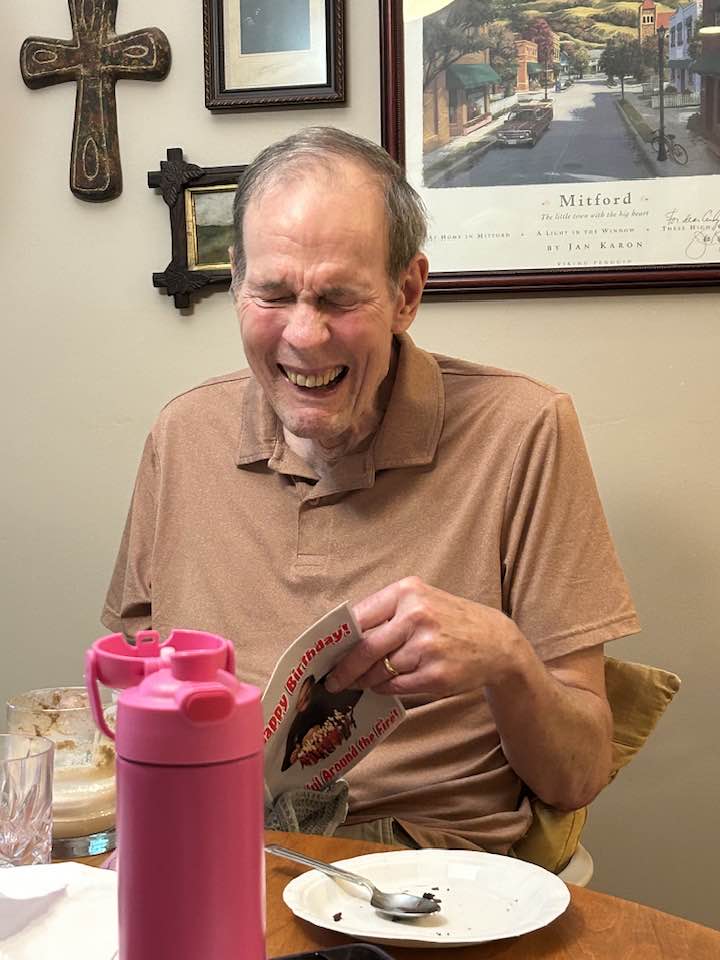
When painting became an outlet during a season of brain-diseased-episodes, he created art that only a mother would love. Or only the artist could appreciate. His best friend told him, “Bill, you’re an artist in your own mind.” Bill compounded the joke by scribbling overpriced valuations on the back of his most ridiculous paintings. One Father’s Day years later, when he was in his right mind, we pulled out his art collection from the attic. He hadn’t seen many of these pieces in a long time, and as he saw them he began to laugh. Ugly laughing—tears streaming down his cheeks and his face frozen in a grimace as he struggled to breathe.
He was often willing to offer himself as the butt of his own jokes, like his tongue-in-cheek alter ego, “Mr. Fix It”—a willing hero who was always depicted applying the wrong tool for the job. He was equally willing to roast his brothers-in-law or send them a two-page invoice after their family enjoyed his hospitality. Or to sacrifice his sons-in-law for comedic purposes. As his first daughter was about to marry me, he said at the rehearsal dinner, “I don’t think of this as gaining a son. I think of it as losing my shirt.”

He was also an author in search of an audience. He wrote because he had to, even if few would ever read his work. His written correspondence with his father-in-law is epic, even if written for only one person. As a former journalist, he wanted to publish, and he achieved that goal in 2019 with a book of extremely limited run. It seems perfect that there’s only one copy of his book available on Amazon right now, and there seems to be a bit of price gouging in play. Perhaps they think the author’s death is going to drive up demand in the resale market. Bill would be the first to find the humor in that.

First followers

It’s easy to say a one-of-a-kind doesn’t need others, but that’s actually untrue. The first to follow someone are the ones who define that person as a leader. As John Maxwell once said, a leader with no followers is just taking a walk. Bill MacNabb could have just taken a walk out of step with everyone else, but something about him drew others to participate in his jokes, his writing and his artwork. He had a huge influence on all who knew him, and we wanted to walk at his pace. So let’s talk about his followers for a minute.

One way we participated was to provide an audience. We listened to Bill’s drafts or helped others realize when he was joking. He fed off the reactions to his dry wit or sarcasm. In one case, he concluded a eulogy for his best friend and walked away silently before returning to the microphone to say, “I usually get applause.” I can still see the funeral director shaking his head at the raucous response. Bill loved it when a message intended for one audience was unearthed. Such as a spoof video he created as sales manager for a heating and cooling company, when he explained how profit was lagging sales, and told customers, “If we had known you would have money left over at the end of the year, we wouldn’t have given you the prices we did.”

The audience also has a role to play. The greatest gift those around Bill could give him was to help him lift his jokes, his writing, his artwork to a level of absurdity. For instance, his kids created a local news video to showcase his journalistic ramblings after a tree exploded behind his house: “A tree explodes! News at 11!” Others created inspirational placemats featuring his Mr Fix It photo series. He knew he was loved when others laughed with him.

We further participate by preserving and celebrating Bill’s writings, artwork, jokes and stories. This week, his first followers have been mining his archives so we can share some of the best at the memorial service tomorrow.

Harnessing limitations

One of the things I’ll remember most about my father-in-law was the way his health-related limitations focused him. Rather than becoming a barrier, they helped him reprioritize. 

He proved able to change and grow, moving away from his workaholism of the years before I knew him to putting his people first throughout his presidency. Frankly, his limitations made him a great president and chairman. Bill was a humble servant leader who loved his company and every employee. He was also capable and competent, leading with wisdom and foresight. Most of his staff had no idea how often he used the couch in his office. If they only knew that his meetings and sales calls were often preceded by a daily ritual of reciting Psalms out loud on his commute so he would sound articulate by the time he walked in the doors. 

Retiring early upon his doctor’s advice gave him more time to focus on people. Bill was incredibly generous, participated in church stewardship campaigns, led the church’s Rock & Roll Evangelism Committee and spent time with his many grandkids—whether they were biological or lived on the street. He also got to know his neighbors during his frequent walks, sometimes taking breaks in front of their homes or dodging a thunder storm in their carports. He then included many of their stories in his second, self-published book. He and my mother-in-law helped build a remarkable community in their neighorhood: this week, there have been as many tears shed up and down his street as among his family.

To the very end, Bill never lost his sense of humor, and joked even when he could no longer speak. Even if he was in pain and visibly struggling with basic activities, if someone asked him how he was doing, his standard ironic response was, “Never had a bad day in my life.” His book title summarizes the reality. His life was lived boldly, with buckets of tears and pails of laughter.

The antidote to ambition: Haman’s altruism

So what steps must be taken to get free of this control and what records do you have of those set free please?

As sydnlm reminds me, all the philosophy in the world doesn’t help when ambition has taken control. Let’s get practical about combating selfish ambition. I don’t have all the answers, but I want to open a discussion, and I hope you’ll add your thoughts.

Erica posted the following comment in response to a previous post on the subject:

“[God has] also taught me that combating envy, bitterness and selfish ambition with delighting in others’ well-being (or good fortune), unconditional forgiveness (through prayer and release to God) and altruism, is quite an antidote!”

Let’s look at those suggestions, and a couple of my own, using the story of Haman. The book of Esther sets the stage over a handful of chapters, describing the increasing tension between Xerxes’ right-hand man and the Jew who antagonizes him by refusing to bow. Haman just will not let this slight go, to the point that he builds a 75′ high gallows just for Mordecai. For good measure, he sets in motion a plan for the genocide of millions of Mordecai’s people.

One morning, the gallows ready, Haman heads to the king’s court to seek permission to avenge his enemy. It’s been a good week. He’s second-in-charge, he was the sole guest at a dinner with the king and queen, and he’s been invited back for dinner again tonight. The king invites him in right away, seeking his advice on the best way to honour someone. Haman’s a smart man and quickly catches the third-person reference; of course, Xerxes is referring to Haman himself. So in his response, he pulls back the curtain on his personal ambitions: wear the king’s robes and crown, ride the king’s horse in a one-man parade, and have one of the most noble officials cry his praises. Xerxes loves the idea and tells Haman to do all of that… for Mordecai.

That scene drips with irony for us, but it was brutal for Haman. He runs home to his wife, mourning and covering his head. She gently points out that Haman has pitted himself against one of God’s people and “will surely fall before him.” Sure enough, everything collapses for him in a day. Haman’s ambition leads to great success for a time, but it shows us some warning signs and ideas that align perfectly with Erica’s comment.

1. Forgive unconditionally. Holding onto perceived slights will literally destroy you. Envy and bitterness ends up holding you captive. It feeds the addiction that may linger at the root of ambition. It blinds Haman and leads him to irrational hatred and genocide. If you peel back the layers, what motivation do you find for your ambition?

This one is very personal for me; it’s taken me years to let go of a comment from a supervisor that fueled my drive for success. I used it as motivation, taking steps for years in a misguided attempt to prove myself to someone who had long forgotten the slight. I recently had an interaction that cast light on that situation and discovered that I have fully forgiven.

2. Altruism. I had to look this one up. Dictionary.com says altruism is “unselfish concern for the welfare of others.” Reference.com adds that altruism goes beyond charity in that it “suggests that the gift may actually cause some harm to the giver.” So to put sacrificial giving in the context of ambition, it means to intentionally sacrifice your own ability to advance in order to push someone else forward. Haman’s altruism was forced on him, but what if he had chosen it? Could he have been saved?

Could an ambitious person deliberately choose altruism? What would happen if he did? I think Henri Neuwen did that. The Henri Nouwen Society tells us of his early years:

He developed quickly into an energetic and enterprising young man who always wanted to assume leadership. Later, his father would say of him that he was very intense and would often ‘flare up’ if his leadership was not recognised.

At age 42, he became a tenured professor at Yale but couldn’t shake his restlessness. He sought another line of ministry in Bolivia but wrote there, “Slowly and painfully, I discovered that my spiritual ambitions were different from God’s will for me.” Comparing thoughts from a number of resources, it seems he became increasingly uncomfortable with the way his desires were being fed. Not only was he struggling with ambition, but some posit that he had a lifelong struggle with homosexual desire. So he walked away. He moved to Toronto and joined the L’Arche community, where he poured his life into the disabled.

3. Pursue opportunities for anonymous generosity. Wikipedia says of altruism that,

Pure altruism consists of sacrificing something for someone other than the self… with no expectation of any compensation or benefits, either direct, or indirect (e.g., receiving recognition for the act of giving).

I agree with Wikipedia that pure altruism is probably not attainable. The closest you can get is to assure complete anonymity in your sacrifice, to intentionally remove the ability to receive recognition. The regular practice of anonymously serving, giving and praising others erodes your desire to build a kingdom for yourself. It won’t take that sin away; there’s a heart issue that needs to be dealt with. But at the least, that drive for success can be redirected towards others. The joy in advancing others can be just as addictive, and far more healthy.

4. Delight in others’ well-being. I have always had a strong sense of ambition. What do you do when your name means “king,” you’re identified as a leader in grade 2, and you’ve always been the youngest at any job you’ve ever put your hand to? For me, my sense of ambition was tempered by a huge gift: At age 37, I was asked to give direction to Wycliffe USA’s leadership development efforts. In other words, I was given a job that required me to expend effort to help others be successful. That meant I rejoiced when I participated in a process that led to the selection of a 40-year-old Latino to the Board, and I rejoiced when a 30-year-old friend of mine became the youngest vice president in Wycliffe USA’s history. On a number of occasions, I had to deal with feelings of jealousy and competition. It was wonderful therapy for me.

5. Studiously avoid taking credit. This is the principle of the window and the mirror: when things go right, think of a window and all the people who contributed to make the initiative successful; when things go wrong, think of a mirror, pointing back at you alone. It’s a discipline I work hard at. Years ago, I set a goal to never make excuses, but to own my mistakes. Then my father-in-law taught me to avoid using singular pronouns in talking about plans and successes. Use “we” as much as possible, and “I” as little as possible. My view has recently been transformed by doing a study through the Old Testament on the phrase, “the Lord was with him.” As I look back on my life, it’s clear that the Lord has been with me and made me successful in some areas where I had no right to be. I often say that it’s God’s sense of humour that He put a graphic designer in charge of a Bible translation organization. There’s very little success that I can claim any credit for. Of course, saying it is one thing. Believing it is another.

Over the last two months, I’ve enjoyed a sermon series on Esther by Mark Driscoll. I borrowed heavily on his thoughts in unpacking Haman’s story. So let me wrap up with some points he made about ambition.

Ultimately, ambition is about seeking glory. The question is, whose glory are you seeking? Most of my points in this post refer to redirecting glory to others. But the only one truly deserving of glory is the King of kings, the Lord of Lords and the President of Presidents. As we seek God’s glory, as we seek to expand His kingdom, as we delight in Him, He redeems our broken, twisted desires and satisfies our hungry souls.

So my conclusion is not to suppress your ambition. Why not seek to do everything you can to bring someone else glory?

Give your product away

The big music labels and filmmaking companies have really struggled with this one. It doesn’t seem to make business sense to let people listen to music free on Pandora or watch movies and shows free on Hulu. Yet it builds the brand and creates more buyers. Social media has inverted many traditional models, and it’s the indie market that’s proving that the economics work… for the most part.

Let me take this one step further. In Getting Naked, Patrick Lencioni tells the tale of a consulting company that never sells. Rather than tell a client what they’ll do if they are hired, they start serving as if they are already hired. Sure, they’re opening themselves to being taken advantage of as they give away the goods, but Lencioni says 9 times out of 10, the client appreciates the generosity. They get a good feel for whether the product is what they really want, and they get a feel for whether your people are the ones they really want to work with. Lencioni didn’t just make this up; it’s his own company’s secrets he’s sharing.

As I learned early on from one of Atlanta’s public relations gurus, always add value. Everything you do or everything you send out should bring value to the person receiving it. We demonstrated it by offering free tips in all of our mailers. Yet every direct mail piece we sent out brought in a client.

My left brain can’t figure it out, but any time we’re open-handed, we end up with more than if we’re close-fisted. My pastor likes to say you can never outgive God. As you give away the things he gives you, he keeps giving you more. It’s not just a spiritual principle. I learned early on that generosity can be good business.