
She grabbed me and made sure I was looking into her eyes. “Coo-rajh!” she told me. It was the early days of my time as president of an organization, and this staff member who had spent many years in Francophone Africa had a clear message for me, which sounds much cooler in French but reads bilingually: “Courage!”
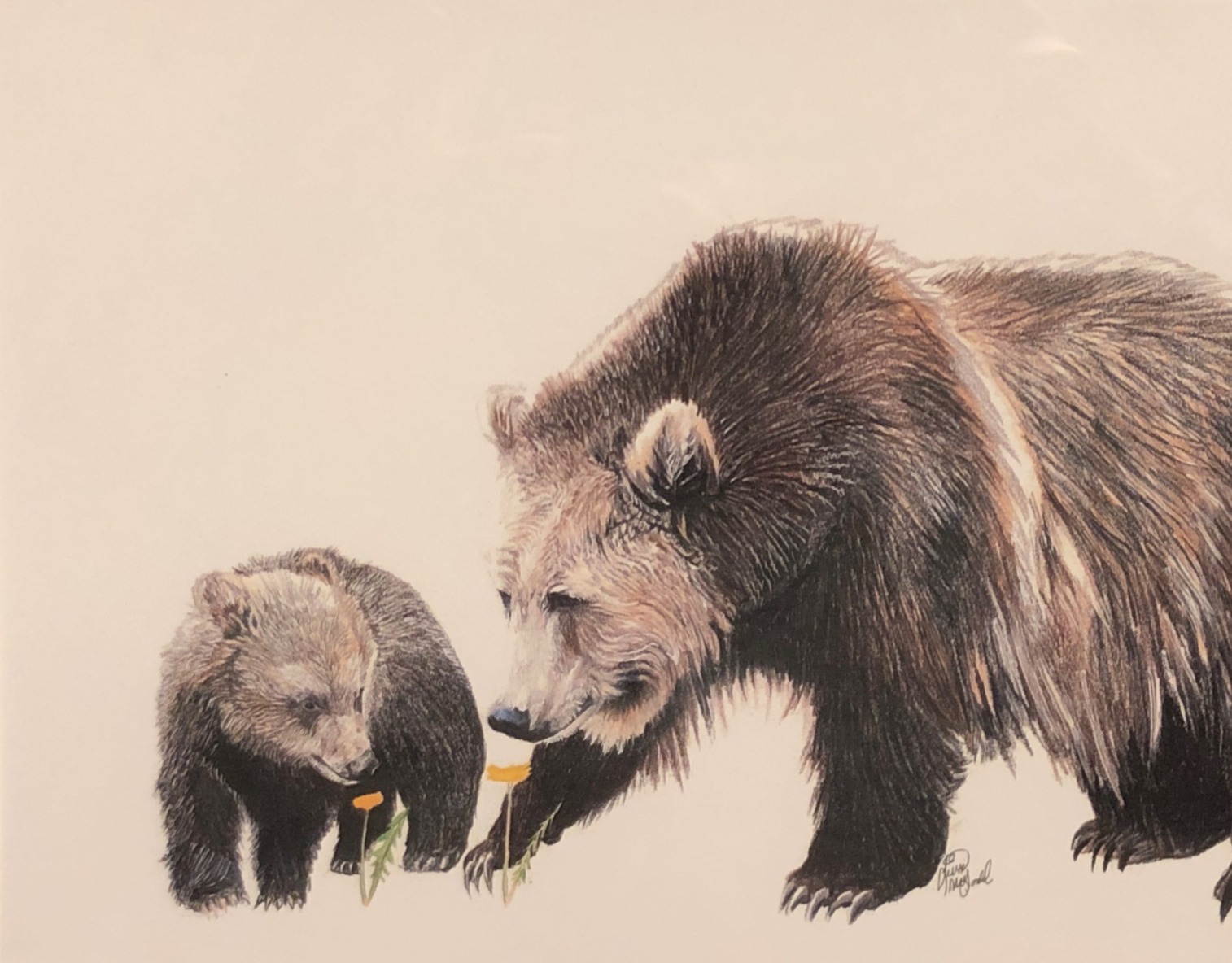
Eleven years later, at my final staff meeting as president, the board presented me with this print from Indigenous artist, Leissa MacDonald. In the artist statement, MacDonald says,
The Bear is a symbol of courage, bravery is taught to us by the bear. Bears are known to confront threats they should be fearful of, they protect their cubs against larger bears and other dangers. The bear also reminds us to be playful and to rest when needed. It is in the balance of these teachings that we are taught how to be courageous.
I’m not sure the board could have given me a greater gift than affirming that I had led with courage. Let’s unpack a few elements in this description and how I sought to apply them.
1. Confront threats (they should be fearful of)
I always reject any suggestion that there is such thing as a “fearless leader.” While I was president, when we would get ready to embark on a new initiative with significant risk, I would lose sleep. I’d be afraid it wouldn’t work. I’d be afraid for those who would be hurt or feel marginalized by the change or who wouldn’t have roles after the change went through. We all have fears.
But my driver on any change was the anticipation of threats. The status quo is a place of safety… for a while. But it eventually becomes a liability and will lead to major issues. I always try to look down the line to see the dangers coming, and address issues early. Threats that seem small today tend to grow. Rather than facing a huge bear in the future, it’s better to face the bear earlier at its current size. Of course, it also occasionally means challenging a huge bear and taking on an issue that cannot be ignored.
What makes this approach particularly difficult is that it’s a prophetic role. The leader looks like a provocateur, stirring up issues that no one else feels are important. People pleasers and procrastinators will always struggle with this role of a leader. When I began serving as president and looked at the long list of issues I inherited, I made a personal promise that I would not hand these challenges off to my successor, but I would address them. I did shorten the list considerably, but I still grieve the ones I wasn’t able to resolve and the new ones that arose (some I likely caused) that I had to leave for my successor.
2. Protect your cubs
In 2 Corinthians 11, Paul lays out a long list of tragedies he’s faced for the sake of the gospel: beatings, shipwrecks, floggings, etc. Then in verses 28-29, he adds,
Besides everything else, I face daily the pressure of my concern for all the churches. Who is weak, and I do not feel weak? Who is led into sin, and I do not inwardly burn?
Part of the role of leadership is to carry deep concern for those you lead. It’s a daily pressure. This includes some who are struggling with change, some who are weak, some dealing with mental health issues, and some who are led into sin. Losses feel very personal. We feel every blow.
So the job of the leader is to to be a mama bear, where no one wants to get between you and your cubs. In The Contrarian’s Guide to Leadership, Dr. Stephen Sample has a rule: No complaining about your team. If a leader delegates something to a team member, she has two choices: support them or fire them. The leader does not get to complain about someone on her team who’s underperforming. If the results aren’t there, the primary strategy available to her is to invest in the person and help get to the bottom of why the staff member is not accomplishing the job that was delegated. Her only other option is to change the delegation, handing the job to someone else.
Protecting your cubs does not mean you don’t have to make courageous personnel decisions. I appreciate another of Dr. Sample’s rules: Shoot your own horse. If a rancher has a sick or hurting pig, cow or sheep, he can get a neighbour to help him put the animal out of its misery. But not a horse. As a rancher’s closest companion and most trustworthy partner in accomplishing his work, if a man needs to put his horse down, he has to look the animal in the eye and do it himself. Sample concludes that a leader must show sufficient respect and courage to fire his own deputies rather than delegate that job. I would add that he should do everything he can to show generosity, care and provision as he does it. In some cases, I’ve been able to eventually turn a former staff person into an ally and advocate even though I inflicted the pain of termination.
Letting a staff member go can be a means of protecting your cubs. I remember a time when I had to let a longtime staff member go, one who had been fighting accountability at every turn. The next day I saw the staff member who had been providing that accountability. Her countenance seemed different. I swear she had a bounce in her step. Remember that you never want to lose good staff because you didn’t address poor-performing staff quickly enough.
3. Play and rest
At first, Leissa MacDonald’s comment about play and rest feels like an incongruity. What is the connection to courage?
It takes courage and faith to step away to take a vacation, a weekend or a good night’s sleep, because it’s an act of releasing control. There’s a story that during the long, exhausting hours of the Second Vatican Council, Pope John XXIII announced one night, “God, it’s your Church. I’m going to bed.” Turning over the keys is primarily a declaration that God is in charge, not us. G.K. Chesterton comments:
The greatest act of faith that a man can perform is the act that we perform every night. We abandon our identity, we turn our soul and body into chaos and old night. We uncreate ourselves as if at the end of the world: for all practical purposes we become dead men, in the sure and certain hope of a glorious resurrection. After that it is in vain for us to call ourselves pessimists when we have this trust in the laws of nature, when we let them keep an armed and omnipotent watch over our cradle. It is in vain for us to say that we think the ultimate power evil when every twelve hours or so we give our soul and body back to God without security. This is the essential sanctity of sleep… (Chesterton, Lunacy and Letters)
Taking time for rest reflects a deep faith in God’s ability to carry your load or manage the organization you steward.
For a leader, there’s never really a good time to step away for rest and play, but it is critical. Reed Hastings has been asked many times to explain the 2-word vacation policy he rolled out at Netflix: “Take some.” Hastings points out that in many young companies, the real issue is that no one uses their vacation days. It’s true for many non-profits as well. Staff work long hours and struggle to step away, especially if the culture or their leader subtly celebrates workaholism. So in 2003, Hastings removed the upper cap on vacation days and began to model vacation-taking. He forced himself to take month-long trips and then told everyone he could what a great time he had. The company survived without him, and often he came back with fresh ideas. It took courage to step away for that long when leading such a huge and growing company. It took even greater courage to trust his staff and remove the constraints.
Let me also add an affirmation for all those who aren’t first-chair leaders. Having recently transitioned back into a second-chair role, I’ve observed that at times there is a peace in knowing that the buck stops with someone else. But it also requires faith and the courage to follow when decisions were made and you weren’t in the room. It’s that same sense of trust that allows a leader to rest and play.
Conclusion
The question for leaders is whether we have the faith to push past our fears and the setbacks and challenges that come our way. My observation is that you don’t necessarily start out with the courage you will need. At the beginning, the threats and challenges look enormous. It’s in the practice of leadership, from the earliest attempts all the way to the first chair (and back down again), where the muscles get developed. It’s a daily practice. Staying in the game, choosing again today to lead rather than be passive, that’s what teaches us to be courageous.
Another of my favorite blog posts on courage can be found here: Courage and Leadership
 the back row leader